Carer in Riga or companion for an elderly parent: what's the difference, and what does it cost?
When Mum needs help, the search results call everything a 'carer'. In reality these are three different jobs at three different prices, and picking the right one decides whether she gets the help she actually needs.

In short
- A nurse or physician assistant gives injections and changes dressings; a carer (aprūpētājs) helps with hygiene and everyday tasks; a companion comes for conversation, walks and errands.
- An hourly carer in Riga usually costs €10–25 an hour in 2026; a 12-hour or live-in carer costs from €1,000 a month through an agency.
- Council home care is free if income is up to €780 a month per household member; above that, the city pays part of the cost or nothing at all. It covers up to 35 hours a week.
- After a hospital stay, ask about state-funded medical care at home: the referral comes from the GP or the hospital doctor in charge of your parent's care.
- Your Native Care provides companions, not carers: €45 an hour on a monthly package, €70 an hour for a one-off visit, with no medical procedures and no round-the-clock care.
A carer in Riga, a home nurse and a companion are three different services. A nurse gives injections, sets up drips and changes dressings. A carer (in Latvian, aprūpētājs) helps with hygiene, meals and everyday tasks, and sometimes lives in. A companion comes for a few hours for conversation, walks and help with errands.
In 2026 an hourly carer usually costs €10–25 an hour, and a live-in carer from €1,000 a month. One private provider charges €50 for a nurse’s call-out plus the cost of the procedure; others charge €10–30 per procedure.
This guide covers who does what, what it costs, where to turn if you need help urgently, and what to ask if you are hiring someone through an advert.
Carer in Riga, nurse or companion: who does what
The confusion is understandable. Whether you search for a carer, a caregiver for an elderly parent or home help, the adverts use the same word for a nurse, a housekeeper and someone who simply sits with Mum. But how you describe the job decides who you end up with.
Nurse or physician assistant. Under Latvia’s Medical Treatment Law (Ārstniecības likums), medical care is provided by medical practitioners listed in the official register. Injections, drips, dressings, wound care and adjusting doses are their job.
Carer (aprūpētājs). This is a separate profession with its own occupational standard. A carer helps with personal hygiene and everyday tasks, and makes sure your parent takes the medicines the doctor has prescribed, but does not prescribe anything. Carers work by the hour, in 12-hour shifts or live in.
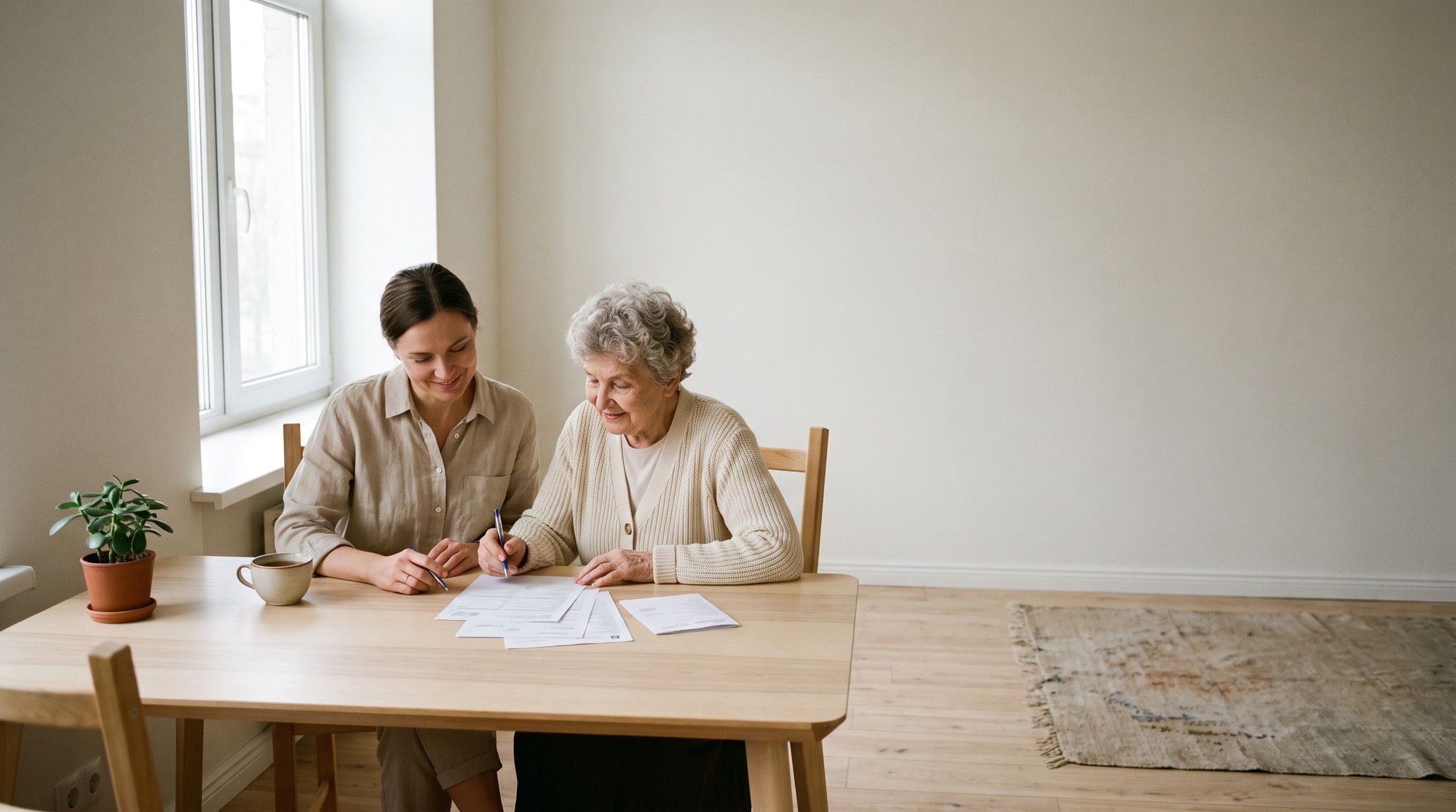
Companion. Someone who comes for a few hours to chat, go for a walk, go along to the doctor or the bank, cook lunch and eat it together. This is how we work.
| Who | What they do | What they don’t do | When you need them |
|---|---|---|---|
| Nurse, physician assistant | Injections, drips, dressings, wound care, sorting medicines into doses | Usually comes just for the procedure rather than staying all day. A nurse-carer on 12-hour shifts or living in is a separate, more expensive service | After surgery, with a chronic illness, when a doctor prescribes it |
| Carer (aprūpētājs) | Hygiene, the toilet, dressing, turning in bed, feeding, cooking, cleaning, laundry, help with taking medicines | No medical procedures; doesn’t prescribe or change doses, which is a job for medical staff | Your parent struggles to look after themselves or cannot get out of bed; supervision is needed for many hours or round the clock |
| Companion (Your Native Care) | Conversation, walks, going along to the doctor and on errands, cooking and eating together, keeping the home tidy, help with the phone and bills, a report to the family | No medical procedures, no lifting or moving someone who is bedbound, no night work, no living in | Your parent generally copes but is lonely, goes out less often, or is getting muddled over everyday matters |
How much does a carer in Riga cost in 2026?
Prices depend heavily on the type of care. These are the prices published on providers’ and platforms’ websites when we checked in September 2026.
| Type of care | Price | Source |
|---|---|---|
| Private carer, hourly | usually €10–25/hr | GetaPro marketplace |
| Basic care under a private contract | €10/hr | Latvijas Samariešu apvienība (Samaritan Association of Latvia) |
| Agency, short visits | 1 hr €25, 2 hrs €30, 4 hrs €50, 8 hrs €90; double at weekends and on public holidays | Amalja |
| Daily visits | one 1-hour visit a day €18 (about €540/month); three 1-hour visits a day €10 per visit (about €900/month); help with a shower from €35 | Senior Group |
| 12-hour or live-in carer (30 days or more) | from €1,000/month; nurse-carer from €1,200/month; agency fee from €200 | Dobroyou |
| Private home nurse | call-out €50, plus injection €25, drip €50, wound care €45–60 | arstsmajas.lv |
| Individual procedures | sorting tablets €10, injection €20, dressing €30 | Aprūpes birojs |
| Council home care | free if income is up to €780 per household member; above that, part-paid or paid in full by the family | Rīgas Sociālais dienests (Riga Social Service) |
| Your Native Care companion | €45/hr on a monthly package, €70/hr one-off | our prices |
So if you are working out what a live-in carer in Latvia costs, budget from €1,000 a month plus the agency’s fee. We did not find reliable published prices for an overnight carer, so we won’t quote figures: ask providers directly. On the classifieds site ss.com, there are over thirty ads from carers looking for work, and almost none of them give a price.
Council home help for the elderly in Riga: free or part-paid
Riga provides home care for people who find it hard to look after themselves because of age or health, if they live alone or have no relatives nearby who can look after them. Income affects only how much is paid, not whether your parent qualifies. The 2026 threshold is €780 a month per household member: below it the service is free, above it the city pays part of the cost or nothing. The number of hours is assessed case by case, up to a maximum of 35 a week (Riga City Council Binding Regulations No. 3 — Rīgas domes saistošie noteikumi Nr. 3).
The list of tasks covers hygiene, help with the toilet, dressing, turning in bed, feeding, cooking, taking medicines, shopping, cleaning, laundry and paying bills. The service is in demand: in the first quarter of 2026, 7,114 Riga residents received it. Check exact amounts and payment rules with social services, as they change from time to time. For more on how to apply and the levels of care, see our article on home care in Riga.
State-funded medical care at home
This is a separate medical service organised by Nacionālais veselības dienests (the National Health Service, NVD). It is for people with a chronic illness who cannot get to the doctor on their own, and for patients discharged after surgery or a stroke. The referral comes from the GP or the hospital doctor in charge of their care, and a nurse or physician assistant does the visits.
For a chronic illness it is provided for up to 30 days, and after surgery for up to 10 days; the GP can extend it. Care starts within 24 hours of the request (vmnvd.gov.lv).
Need a carer urgently? Where to turn in the first few days
Usually, “urgent” means Mum is about to come out of hospital. Here is what to do, in order.
- While Mum is still in hospital, speak to the doctor in charge of her care and the ward social worker. The doctor can refer her for state-funded medical care at home: a nurse or physician assistant visits, and care starts within 24 hours of the request.
- If Mum is being discharged from Stradiņš Hospital or Riga East Hospital (Paula Stradiņa klīniskā universitātes slimnīca, Rīgas Austrumu klīniskā universitātes slimnīca), ask about the “Integrēta aprūpe mājās” (“Integrated care at home”) pilot. It runs from 3 August 2026 to 31 July 2027 for Riga residents who need both medical and social care after discharge. Referrals come from the hospital doctor and the hospital social worker.
- Apply to Rīgas Sociālais dienests (Riga Social Service) at the office for the area where your parent lives. The central office is at Baznīcas iela 19/23, telephone 67105048, soc@riga.lv. You will need an application form, an identity document, a letter from the GP describing what your parent can no longer do for themselves, and proof of income. You should get a decision within a month of handing in the documents. The process is described on the website of Rīgas domes Labklājības departaments (Riga City Council Welfare Department).
- If your parent needs more than 35 hours of care a week, for example while recovering, ask about short-term residential care (īslaicīgā sociālā aprūpe): up to 30 days a year, part-funded by the city.
- While the applications are being processed, you can hire a private carer or use one of the agencies in the table above. You will have to pay, but it can be arranged quickly.
We haven’t included ourselves in this list: it usually takes about a week from your first call to the first visit, because we match a helper to your parent rather than sending whoever is free.
Looking for a carer for Mum: a short checklist
Before you start ringing round adverts, answer a few questions for yourself. The answers will tell you who you need.
- Does she need injections, drips, dressings or wound care? You need a nurse: through the NVD on a doctor’s referral (if Mum cannot get to the doctor, or after surgery or a stroke) or privately.
- Is Mum unable to wash, use the toilet or dress on her own, or is she bedbound? You need a carer. Start by applying to the council’s social services, and look at agencies at the same time.
- Does she need someone with her at night, or can’t she be left alone for more than a couple of hours? You need a 12-hour or live-in carer, or residential care. A companion is not the right fit here.
- Is she coping on her own but lonely, no longer going out, or getting muddled over bills and doctor’s appointments? A carer isn’t necessary here: a companion for a few hours a week is enough.
- Do you live far away or abroad and not really know how she is doing? Then what matters most is a report after every visit and a single contact who answers the phone.
- Which language is she comfortable in? For an older person this often matters more than you might think.
Often the answer is a combination. For example, council home care on weekdays, a nurse on a doctor’s referral after surgery, and a companion at weekends.
Hiring a private caregiver through an advert: what to ask before day one
If you have placed an advert for a carer in Riga, or are replying to a carer’s own advert, there are a few things to agree before the first working day. This isn’t about suspecting anyone; it’s simply good practice and protects both sides.
- Will there be a written contract? What the duties are, how many hours, and how pay is calculated at weekends and on public holidays.
- What happens if the carer is ill or on holiday? Agree in advance who will cover. Agencies set out their replacement terms in the contract, so read them before you sign.
- How much does the agency take? Some agencies don’t publish prices and charge a fee as a percentage of the carer’s pay. Ask for the amount up front.
- Can you speak to previous families? Ask for references and ring them.
- Do they have a criminal record certificate? The person will be alone in the home of an elderly relative, and asking for an extract from the Punishment Register (Sodu reģistrs) is perfectly normal.
- What is their tax status? Check whether the person is registered with the State Revenue Service (VID) as self-employed (saimnieciskās darbības veicējs). If not, the family may become responsible for the tax. Check the rules at vid.gov.lv.
- What won’t the carer do? If an advert promises injections and drips, ask about medical qualifications: those procedures are a job for medical staff.
Why a companion costs €45–70 an hour, and who doesn’t need one
We cost more than an hourly carer, and we don’t hide it. Our monthly packages are 8 hours a month for €360, 15 hours a month for €675 and 24 hours a month for €1,080, which works out at €45 an hour. That means several visits a month, not round-the-clock care. A one-off visit is €70 an hour, for a minimum of 2 hours.
For the extra cost you get a different kind of service. We match a helper to your parent’s personality, interests and language (Latvian or Russian) and introduce them before the first visit. The family has one coordinator, a short report arrives after every visit, and if the helper is ill, we find a replacement. You can live abroad and still arrange everything: you pay, and the reports come to you. We interview every helper and check their references and criminal record (an extract from the Punishment Register). There is no long-term contract, and you can start with a single visit. Find out more on our how it works page.
What we don’t do:
- we are not a medical service: we don’t give injections, change dressings, administer medicines or adjust doses;
- we don’t lift or move people who are bedbound, as that needs a trained carer;
- we don’t provide round-the-clock care or live in.
We do remind your parent to take the medicines their doctor has prescribed, and we let the family know if their health seems to change.
Council home care covers hygiene and everyday tasks, but not conversation, walks or leisure. That is the gap we fill, along with going to appointments at an unhurried pace, which is why many families use both. You can see exactly what a visit includes on our services page.
When you need a carer, not us
To save you time: if Mum needs help with washing, the toilet and dressing every day, if she is bedbound, or if she cannot be left alone at night, you need a carer or residential care, not a companion. A two- or three-hour visit from us cannot replace someone who will help her to the toilet at three in the morning.
If she needs many hours of care every day, it’s also worth considering a care home. Since 2025 the city part-funds a place in a care home if your parent needs 25 or more hours of care a week (previously 35). We cover prices and the process in our article on how much a care home costs in Latvia.
We are the right fit when the main care is already in place, or not yet needed, but Mum misses having someone around: someone to go for walks with, to take her to the doctor and explain what was said, to sort through the post and share a cup of tea. If you are not sure which option suits you, have a look at our FAQ or book a free online meeting: we will tell you plainly if we are not what you need.