When can someone with dementia no longer live alone at home?
There is rarely a single day when it becomes obvious. But there are signs you can spot in time, and steps you can take before something serious happens.
In short
- The main warning signs: the gas or hob left on, getting lost, falls, missed medicines, unpaid bills and mixing up day and night.
- Six in ten people with dementia will wander off and get lost at least once. If your parent goes missing, start searching straight away, and if you have not found them within 15 minutes, call 112.
- Support can be stepped up gradually: family and regular visits, council home care of up to 35 hours a week, a day centre, and finally round-the-clock care.
- In September 2026 around 700 people in Riga were waiting for a care home place or council co-funding, at least half of them with dementia. It is worth applying early.
- Visits help as long as your parent is safe in between. Once they need supervision around the clock, visits are no longer enough.
When can someone with dementia no longer live alone? When the hours on their own start to put them in danger: the gas is left on, they go out and cannot find their way back, they fall, they stop eating or taking their medicines. It is not the diagnosis or the name of the dementia stage that decides this. It is what you see happening day to day.
This article picks up where the early signs of dementia leave off: the point when the family has to decide how much supervision is needed. Below you will find a checklist of warning signs, ideas for making the home safer and the levels of support available in Riga.
Warning signs that someone with dementia can no longer live alone
There is no single official list. These are the signs that dementia organisations mention, plus the ones families often notice for themselves. The more of them you recognise, the less time your parent should spend alone.
Safety
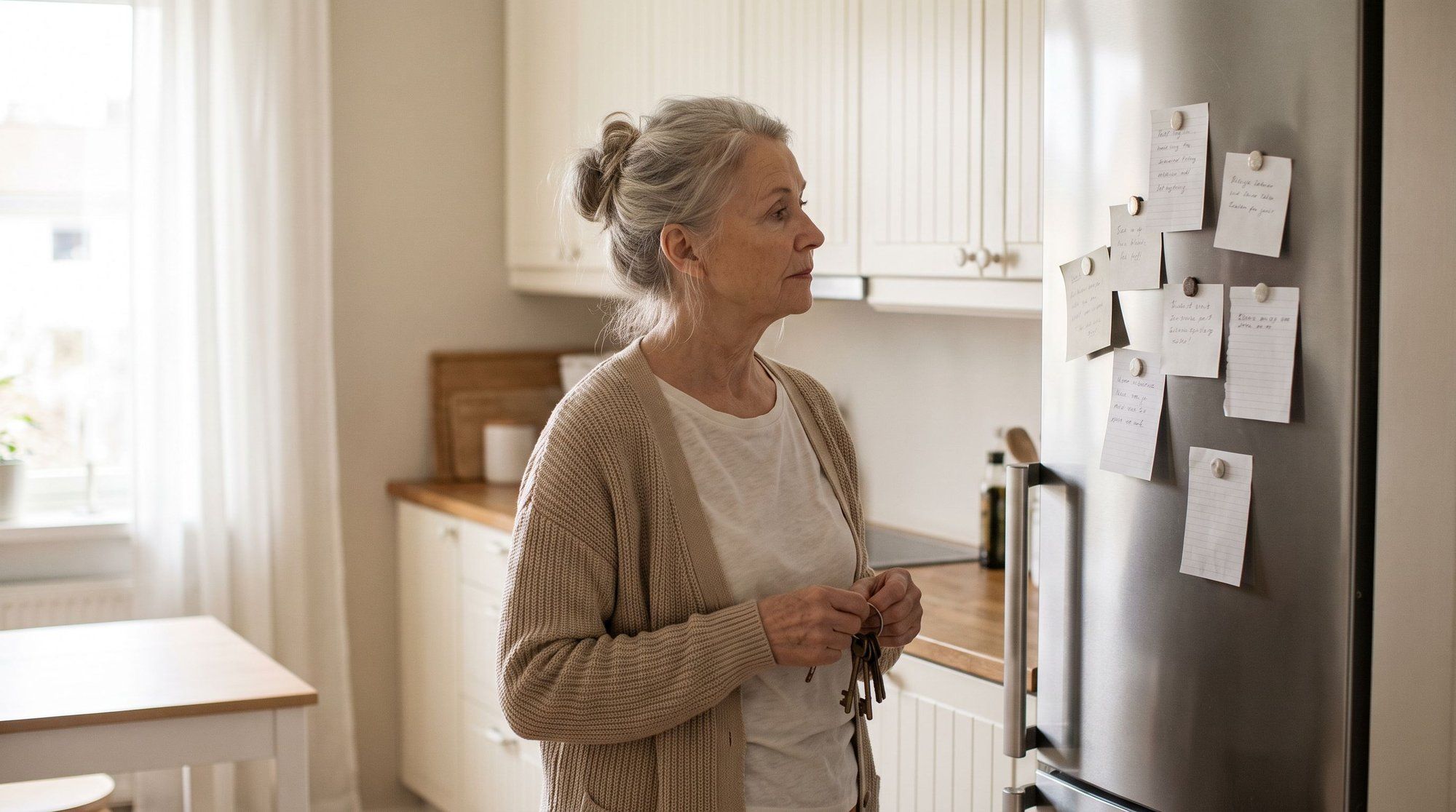
- The hob or gas is left on, or a pan is forgotten on the heat.
- The front door is left open or unlocked.
- They come home later than usual, or forget a route they have walked for years.
- In their own flat they cannot find the room they want, or say they want to “go home” when they are already at home.
- They pace up and down restlessly and cannot settle.
- They have had a fall, or have nearly fallen several times.
Getting lost is not unusual. According to the US Alzheimer’s Association, six in ten people with dementia will wander off and get lost at least once. The Association also notes that a person with dementia who lives alone may face a higher risk of falls, wandering, poor nutrition and neglected hygiene.
Health and daily life
- Tablets are left in the pill organiser, or it is unclear whether today’s dose has been taken.
- Food sits untouched in the fridge or goes off.
- They wear the same clothes for several days and no longer wash as they used to.
Money and strangers
- Unpaid bills and reminders pile up in the letterbox.
- They open the door to strangers or fall for scams.
Day and night
- They mix up day and night, staying awake at night and sleeping during the day.
- They are alone at night, and nobody would notice if they went out or fell.
Write down what you notice and when. These notes will be useful when you talk to the family doctor, a social worker and your siblings.
If your parent goes missing: act straight away
The Alzheimer’s Association advises searching straight away, in the immediate area and the places they usually go. If you have not found them within 15 minutes, call 112. Do not wait for them to come back on their own.
If your parent has already got lost once, treat it as a warning rather than a one-off. That is the moment to rethink how many hours they spend alone.
Living alone with dementia: making the home safer
The NHS suggests several simple changes to the home:
- good, even lighting, motion-sensor lights, and lights on the stairs and on the way to the toilet;
- no rugs to trip over; contrasting colours for doors, handrails and the toilet seat;
- mirrors removed or covered, curtains drawn in the evening;
- labels with pictures on cupboards and doors;
- a clock that shows the date, a phone with large buttons, notes and reminders.
These also help:
- Cooker and gas: knob locks or removing the knobs, turning off the gas supply, an automatic gas shut-off valve.
- Medicines: a weekly pill organiser, a list to tick off, all other medicines locked away.
- Personal alarm: in 2026 Latvijas Samariešu apvienība (the Samaritan Association of Latvia) charges €26–33 a month for this service, and Riga City Council also runs its own service. Ask the social service whether your parent is eligible.
Adaptations reduce the risk, but they do not replace having someone there.
Dementia stages and levels of support in Riga
What matters more than the name of the dementia stage is what your parent can still manage on their own. Needs usually grow gradually, so support can be stepped up one level at a time.
| Level | What it is | When it is right |
|---|---|---|
| 1. Family and regular visits | Relatives, neighbours, a helper a few hours a week | Your parent is safe between visits |
| 2. Council home care | Up to 35 hours a week, arranged by Rīgas Sociālais dienests | Help is needed with washing, meals, medicines and housework |
| 3. Day centre | Six centres in Riga, free for Riga residents | They cannot be left alone during the day, but someone is with them in the evening and at night |
| 4. Round-the-clock care | A care home with a dementia unit, or someone present at home at all times | Supervision is needed around the clock |
1. Family and regular visits
At first it is enough for someone to drop in regularly: share a meal, check the fridge and the pill organiser, go for a walk. What matters is that visits are predictable and that someone keeps all the notes in one place. Now is also the time to adapt the home and agree who does what, so that it does not all fall on the same person.
2. Dementia care at home in Riga: council home care
In Riga, home care (aprūpe mājās) is available to adults who, because of age or a health condition, genuinely struggle to look after themselves. They must have their residence declared in Riga and actually live there. They must live alone, or the family members living with them must be unable to provide care because of age, health or work.
You apply to Rīgas Sociālais dienests (Riga Social Service). You will need a certificate from the family doctor, proof of income and, if your parent has a mental health condition, a psychiatrist’s report. A decision is made within a month.
The number of hours depends on the assessment, and the council funds up to 35 hours a week. In 2026 the service is free if household income is no more than €780 a month per person. If income is higher, the council may pay part of the cost; check the current conditions with Rīgas Sociālais dienests.
The service covers personal hygiene, cooking and help with eating, help with taking medicines, shopping, cleaning and laundry. Conversation, walks and leisure time are not on the list of services.
Demand is growing: in the first quarter of 2026, 7,114 Riga residents received home care, and a growing share of it is intensive care, including for people with dementia. Whether the same person comes each time, and at what time, depends on the provider and the hours allocated. For more on applying and costs, read our article on home care in Riga.
3. Day centres for people with dementia
Riga has six day centres for people with dementia, and they are free for Riga residents. Your parent must have their residence declared in Riga and be assessed by Rīgas Sociālais dienests. You will need an application form, a certificate from the family doctor confirming the dementia diagnosis and, if required, a psychiatrist’s report. A decision is made within 22 working days. They can try a centre for one to five days, paying only for meals.
Families should also know about the Konsultatīvais centrs demences jautājumos (the dementia advisory centre) at Ģertrūdes iela 12 (weekdays 8.30am–5.30pm, telephone +371 61111161). It offers free consultations, seminars and support groups. If you need a break yourself, ask the social service whether your parent qualifies for respite care (“atelpas brīdis”), up to 30 days a year.
4. Round-the-clock care at home or in a care home
Council home care cannot provide round-the-clock care, as it is limited to 35 hours a week. If more is needed, the council offers short-term residential care, supported living or a long-term place in a care home (pansionāts). Since 2025, anyone who needs at least 25 hours of care a week can get a care home place part-funded by the council, provided they have had their residence declared in Riga for at least 12 months.
Care home places for people with dementia are scarce. The council’s three care centres in Riga have around 600 places, about 200 of them for people with dementia. In September 2026 around 700 people were waiting for a place or co-funding, at least half of them with dementia. Partner care homes usually offer a place within about a month, but the wait for the dementia units of the council’s own centres is longer. In 2026, private care homes charge around €2,400–2,900 a month for intensive or dementia care. We compare prices and co-funding in our article on how much a care home costs in Latvia.
When visits are no longer enough
Visits help as long as your parent is safe in between. If they keep getting lost or leaving the gas on, go out at night, or fall and cannot get up, visits alone are probably no longer enough. No helper who comes for a few hours can see what happens the rest of the time.
In the Latvian Ministry of Welfare’s description of care levels, the highest, level IV, means the person needs “full care and supervision around the clock”. At that point the real question is who will be with them all the time. Because the waiting lists are long, it is worth applying for a care home place early, while you are still coping at home.
How to talk about it with your parent and your siblings
With your parent, talk somewhere calm and well lit, at eye level. The UK’s Alzheimer’s Society recommends short sentences, one idea at a time, with pauses. Instead of an open question, offer a choice: “Would you like the helper to come on Tuesdays or Thursdays?” Show that you understand how they feel, and do not argue about things that do not matter. If frustration builds, come back to it later. There is more on this in our article on talking to someone with dementia.
With your siblings, be specific. Show them your notes, share out the tasks and agree who keeps in touch with the social service and the doctor. If you disagree, a neutral view can help: the family doctor, the social worker who assesses care needs, or an adviser at the dementia advisory centre.
It is best to make the decision together with your parent, while they can still take part. This article does not cover legal matters such as powers of attorney; for those, take advice from a lawyer.
Where Your Native Care can help, and where we cannot
We are helpers who visit your parent regularly. A helper cooks and eats with them, goes for walks, chats, reminds them about the medicines their doctor has prescribed, goes with them to appointments, and helps with shopping, bills and letters.
After each visit the family gets a short report, and we let you know if your parent’s wellbeing changes. If you live abroad, you can pay for the service and receive the reports online. We match the helper to your parent’s personality, interests and language, Latvian or Russian. It usually takes about a week from the first call to the first visit, there is no long-term contract, and you can start with a single visit. See our services for more detail.
In 2026 our monthly packages cost €360 for 8 hours, €675 for 15 hours and €1,080 for 24 hours a month. That is the total number of hours in the month, not round-the-clock care. A one-off visit costs €70 an hour (pricing), and every visit lasts at least two hours. Our rate is higher than a privately hired carer’s (€10–25 an hour) because the service is different: a helper matched to your parent, a coordinator, reports and cover when your helper is away.
What we do not do: we are not a medical service, we do not give injections or change dressings, we do not administer medicines or change doses, we do not move bedbound people when that needs a trained carer, we do not work around the clock and we do not live in. We work alongside council care, not instead of it. If your parent can no longer be left alone between visits, our help can only be one part of the answer, together with a day centre, council home care or a care home.